
INSIGHTS
Introducing TaxMiner™: What It Is, Why It Exists, and What It Deliberately Does Not Do
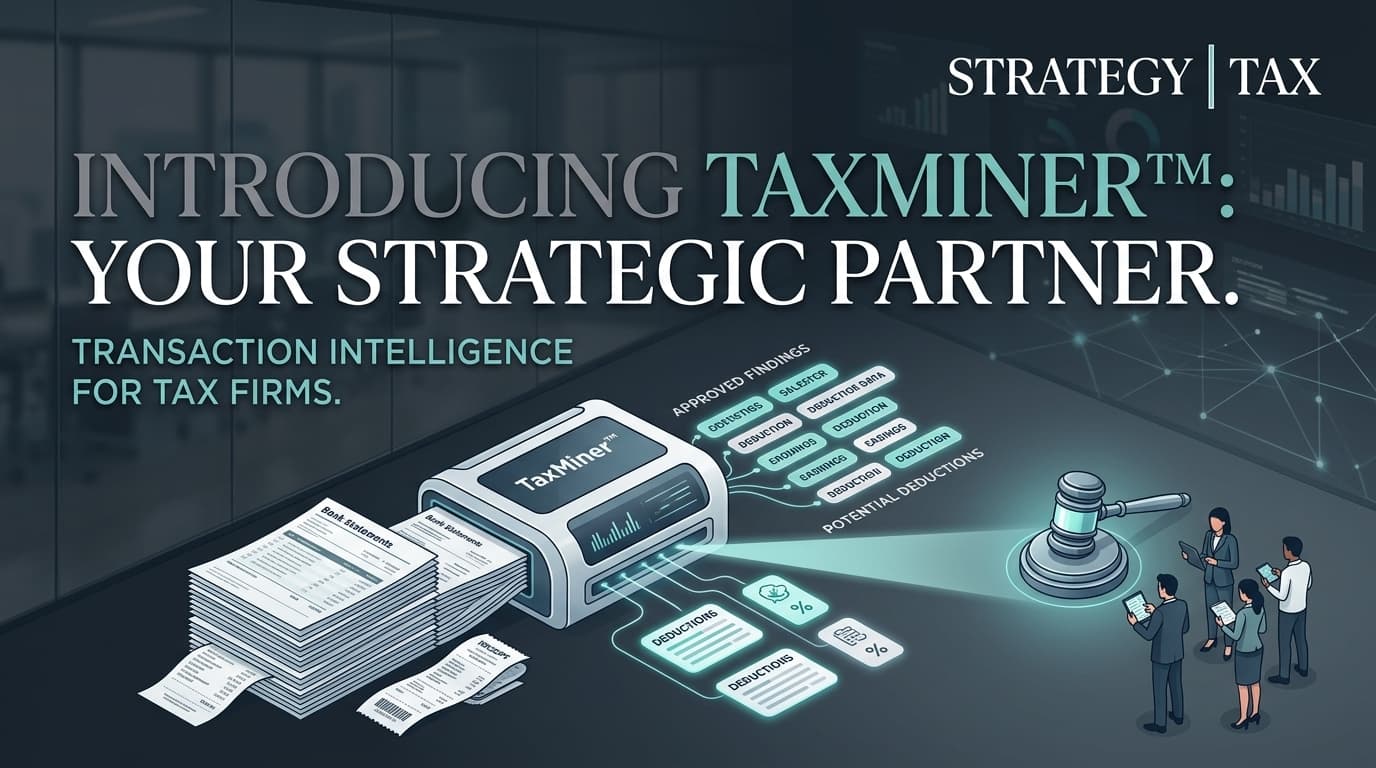
Every client bank statement is a record of business expenses that nobody had time to read. TaxMiner™ reads it, and then hands every finding to a licensed professional to decide.
The problem, in numbers
Tax firms are being asked to look at more data with fewer people. According to AICPA figures cited in industry reporting, first-time CPA exam candidates fell from 48,004 in 2016 to 32,188 in 2021, a 33% drop. Separate reporting based on Bureau of Labor Statistics data says the profession has lost more than 300,000 accountants and auditors since 2020, roughly 17% of the workforce. Retirements are outpacing new entrants, and new graduates take years to become senior-ready.
Now put that next to the work itself. In the sample client file in our product walkthrough (illustrative data, not a real client), a single tax year contains 1,248 transactions across three accounts. Those transactions sort into 15 potential deduction categories, and 7 items need a human decision. Multiply that by a client roster, and add the fact that the descriptors on a statement rarely help. A hardware store run during an office build-out, a software subscription buried among consumer charges, and a year of rideshare that never reached a mileage log all look like ordinary spending.
Most missed deductions aren’t exotic strategies. They are ordinary business spend that nobody had the hours to find. That gap is what deduction discovery software exists to close, and it is why we built TaxMiner.
1. What is TaxMiner?
If you are searching for “what is TaxMiner,” here is the short answer: TaxMiner is Strategy Tax’s transaction intelligence engine for tax firms. It analyzes a client’s bank and credit-card activity, sorts transactions into deduction categories, and surfaces potential business expenses as proposed workpaper items for a qualified professional to review.
It is a form of deduction discovery software, but the word “discovery” is doing careful work here. TaxMiner discovers candidates. It does not decide. Every category opens to the transactions behind it (date, merchant, amount), and nothing moves forward until a person approves it.
It is also designed as tax firm workflow software rather than a standalone calculator. It connects to client accounts, produces a review queue, compiles approved items into a deduction schedule with the source record attached to each number, and can serve as the secure document layer behind the engagement. You can see how it fits together on the TaxMiner page.
2. Why TaxMiner exists
Three things kept showing up in conversations with tax professionals.
Reading statements line by line doesn’t scale. Nobody catches everything by scanning a year of transactions. There isn’t time, and merchant names don’t cooperate. The result isn’t carelessness. It is arithmetic: more clients, more accounts, and the same number of hours.
Rules create hidden decisions. Business meals are generally 50% deductible, while meals tied to marketing activity can qualify for full deductibility. A rule like that turns every restaurant charge into a judgment call. Professionals need those calls in front of them, with the evidence attached, rather than buried in a spreadsheet.
Clients mix their spending. Business costs often get paid through personal bank or credit-card accounts. Separating them is tedious work that tends to get skipped when deadlines tighten.
So we built a tool that does the tedious first pass at scale and leaves the professional judgment where it belongs, with the professional.
3. What TaxMiner deliberately does not do
This is the section we care about most, because the boundaries are the product as much as the features are.
It does not file or claim anything on its own. No amount is filed, claimed, or added to a final deliverable solely because TaxMiner identified it. AI-assisted classifications remain proposed workpaper items until a qualified person reviews them.
It does not prepare or file tax returns, and it is not tax advice. TaxMiner identifies potential deductions for professional review. All deduction decisions remain with the licensed professional using the platform.
It does not automatically treat personal spending as deductible. When a client authorizes it, TaxMiner can review personal accounts to separate potential business expenses from personal ones. It does not automatically classify personal transactions as deductible or replace professional judgment.
It does not take your credentials, your data, or your responsibilities. Bank connections run in read-only mode, and Strategy Tax never receives or stores the client’s banking credentials. Client data is not sent to public AI services and is never used to train an AI model. And Strategy Tax supports your firm’s compliance obligations without assuming them. Your firm remains responsible for its professional, legal, and recordkeeping requirements.
Each of these limits is deliberate. A tool that quietly decided things for a licensed professional would be more dangerous than useful. We would rather be a very good first pass than a risky final word.
4. How TaxMiner fits a tax firm’s workflow
A firm evaluating tax firm workflow software should ask two questions: where does the work happen, and where does the data go?
The work. Clients connect accounts through Plaid. TaxMiner scans the activity and builds a review queue. The preparer expands each category, unchecks anything that doesn’t belong, and sees the totals update. What they approve compiles into a deduction schedule, and a clear review history is kept for each client file.
The data. axMiner uses Qwen, an open-weight model operated on Strategy Tax-controlled compute, so client data is not sent to outside AI services. Transaction records are kept in an encrypted AWS environment, and supporting documents are kept in Onehub, with encryption in transit and at rest. Controls are designed with the FTC Safeguards Rule, GLBA, IRS Publication 4557, and IRC §7216 in view, and our infrastructure providers hold SOC 2 certification.
Retention is defined rather than open-ended. Client records and documents are kept for one year and then permanently deleted. AI inputs and outputs are not retained, system logs are kept for six months, and backups expire after 30 days.
What TaxMiner does
We read the statements so your team can spend its hours on judgment.
When a client connects their accounts, we pull transactions in read-only mode and sort them into the categories tax professionals actually work with: meals, technology fees, travel and lodging, marketing, office supplies, rent, cell phone, cable and internet, legal fees, and more. Every category card opens to the source transactions behind it.
We put the 100% versus 50% meals question under your control. Set the marketing percentage with a slider, and the deductible totals recalculate in front of you while the underlying transactions stay visible.
We let you approve every line. Uncheck anything you don’t want included and the totals update. What you approve becomes the deduction schedule, with the source record attached to every number.
We look at personal accounts, with the client’s authorization, and produce a transaction-level bookkeeping report that supplements the business records you already have.
And if you want one less system to pay for, we can serve as your firm’s secure document-storage layer, keeping client records organized alongside the transactions and schedules they support.
We find the candidates. You make the call.
Your next step
Bring one client file and see what TaxMiner finds.Book a 20-minute walkthrough → and we will show you the review workflow on a real set of books, including how approval, data handling, and retention work in practice.
Want to size the opportunity first? Try the Revenue Opportunity Calculator →.
Disclaimer: Strategy Tax is a trading name of MT Global USA LLC. TaxMiner™ identifies potential deductions for professional review. It does not prepare or file tax returns and does not constitute tax advice. All deduction decisions remain with the licensed professional using the platform. Figures from the product walkthrough are illustrative sample data. Industry statistics are drawn from third-party reporting of AICPA and Bureau of Labor Statistics data and are provided for context only.